It's ironic to be posting about drought in the middle of the monsoon season--if we don't get any more rain than we've had in the East Mountains, that's all we'll be talking about. Not a day goes by that we don't get calls about distressed landscapes. "But it rained--but I water--but..."
For the second year in a row, we're at a deficit for water retained in the soil. The snow pack ran off too soon in the unseasonal warmth of early spring, or evaporated. The rain falls on dusty clay, beads up and runs away too. What we need rainwise is weeks of daily, slow soaking falls. Failing that, plants desperately need to be mulched--even if you're watering. Especially if you're watering. Irrigation water is precious here in New Mexico. Trap that water. Don't put a plant in the ground without working in compost. If you can't work the ground, put it on top. Animal manure is free for the hauling in most cases. The transfer station has chips that are free if you load your own. Compost traps water.
Catch that water. The miscellaneous array of tanks in the photo hold an extra thousand gallons of rainwater in addition to the 5,000 gallons the big cistern in the back captures. On the east side of the barn, another 3,000 gallon cistern catches rain from the roof on that side. Two more white tanks catch the overflow. We use this water sparingly, eking it out from landscape, to fruit trees, to hoophouses. Everyone in New Mexico should have a catchment of some kind. If you're in the Edgewood Soil & Water Conservation District, you can get as much as 50% back on the purchase of a rainwater catchment system, including the guttering. Consider plumbing a greywater system if you don't already reuse the water from showers, sinks, etc.
New plants must be watered everyday in a season like this. If you have the water, water deeply; if you get the root zone soaked down to at least a foot or more, you can skip a day or two, or more depending on the plant. Most folks, like us, have to ration; a splash on every plant just enough to keep it going till the rain comes.Check your irrigation system if you have one. If you're losing water to an inefficient layout, water by hand. The hose revolutionized agriculture!
The signs of drought--wilting, greyness or a dusty look, leaves cupping or curling, yellowing, leaves turning brown on parts or the whole leaf, crunchy leaves, leaf drop. Twigs and small limbs may die back. Flowering perennials may stop blooming; buds may droop and brown. Insects are attracted to stressed plants.
resources on drought
www.harvestingrainwater.com/ --amazing information from Brad Lancaster
http://www.squidoo.com/garden-drought
http://news.uns.purdue.edu/x/2007b/071005BeckermanDrought.html
http://www.westernresourceadvocates.org/water/rainharvesting.php --codes from all over
PO Box 2458, Tijeras NM 87059
Mountain Gardens--finding success with plants for the high desert and East Mountains of New Mexico
Wednesday, August 1, 2012
Tuesday, July 24, 2012
Sphinx Moth
They are horn worms but this one is in its final instar and has shed the horn leaving an 'eyespot'. They feed on grape, Virginia creeper, and woodbine. The mature caterpillar is two or more inches in length, and the adult moth's wings can span your palm. The adult, like most hawk moths, feeds at night, sipping from flowers, pollinating as they go.
When disturbed, the caterpillar can retract its entire head. (bottom photo)
Friday, July 20, 2012
Addendum to the Wildlife Talk: Voles & Bio-bugs
Couldn't squeeze everything into the Wildlife talk last week, so here are a couple of interesting tidbits.
Just when it seems like every bug is a bad bug (or the only good bug is a dead bug?), some new research comes out reminding me that there are lots of beneficials out there too. One of the most pernicious weeds we have in the East Mountains is bindweed, an exotic invasive morning glory; anathema in field crops, a terror in flower beds, there hasn't been much that could be done to defeat it. Birds plant seeds that can still germinate after 50 years (!); roots 20 feet deep laugh at herbicides; every bit of root left when digging it out--becomes a new plant. It's the cockroach of the plant world.
But now, according to Organic Gardening, hope has arrived in the form of the bindweed mite. After 14 years of testing, the mite is being distributed through a variety of programs (I'll let you know when I find it). The mite doesn't feed on native morning glories or other desirable plants. It is effective at controlling bindweed in lawns and gardens, as well as in fields.
This next is not a problem we've had at the farm, but we have had a few clients pulling their hair out over voles. These tiny rodents can do a lot of damage in orchard and garden, and can be very difficult to control. An article in The American Gardener magazine (the American Horticultural Society) made a good case for using expanded aggregates, particularly shale to keep voles out of beds. The product name is VoleBloc, and a two inch layer below the root ball effectively blocks voles. The material is used to backfill the planting hole, and 'mulches' the top too. Wonder how it works on gophers?! Got to be easier than making a basket from hardware cloth.
Just when it seems like every bug is a bad bug (or the only good bug is a dead bug?), some new research comes out reminding me that there are lots of beneficials out there too. One of the most pernicious weeds we have in the East Mountains is bindweed, an exotic invasive morning glory; anathema in field crops, a terror in flower beds, there hasn't been much that could be done to defeat it. Birds plant seeds that can still germinate after 50 years (!); roots 20 feet deep laugh at herbicides; every bit of root left when digging it out--becomes a new plant. It's the cockroach of the plant world.
But now, according to Organic Gardening, hope has arrived in the form of the bindweed mite. After 14 years of testing, the mite is being distributed through a variety of programs (I'll let you know when I find it). The mite doesn't feed on native morning glories or other desirable plants. It is effective at controlling bindweed in lawns and gardens, as well as in fields.
This next is not a problem we've had at the farm, but we have had a few clients pulling their hair out over voles. These tiny rodents can do a lot of damage in orchard and garden, and can be very difficult to control. An article in The American Gardener magazine (the American Horticultural Society) made a good case for using expanded aggregates, particularly shale to keep voles out of beds. The product name is VoleBloc, and a two inch layer below the root ball effectively blocks voles. The material is used to backfill the planting hole, and 'mulches' the top too. Wonder how it works on gophers?! Got to be easier than making a basket from hardware cloth.
Sunday, July 15, 2012
Pre-sprouting Experiment Continues
Picked the first kohlrabi and made a very tasty slaw for dinner. Am increasingly impressed with the kohlrabi. It's tough in cold or heat, fast to mature, adds a pretty touch in purple or green, bugs don't seem to care for it, and it's versatile in the kitchen. I also like it sliced for a bit of crunch in salad, or in stir fry. Going to try a puree next.
The garden looks great overall. Ahhh, zucchini.
Sunday, July 8, 2012
Aphids Again
| Just a few aphids.... |
Keep reading in the journals that aphids and other insects that are real nuisances in commercial growing are becoming resistant to many products that have been used in the past. Some growers are maintaining stocks of "wild" non-resistant aphids to breed back into their greenhouse pests.
This is becoming the year of the bug...
| ....multiply overnight |
Friday, July 6, 2012
More Bugs!
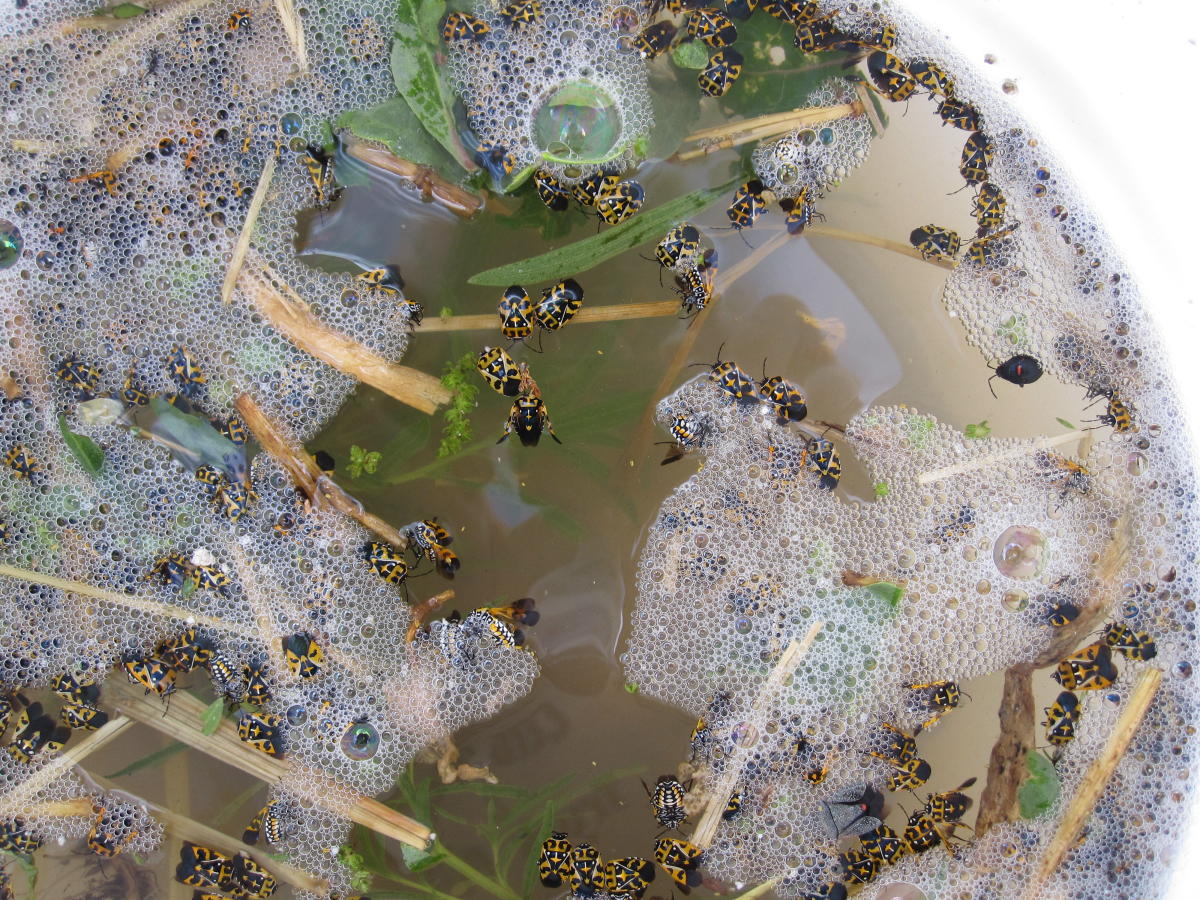
Harlequin & squash bugs have joined the host of aphids and flea beetles that have been plaguing my garden. They're easier to deal with--the adults are difficult to kill with sprays, so this is one of those times the organic approach works better. I spent an hour dropping them into a bucket of soapy water. Then I combed through my squash looking for eggs. Only found a few squash bug eggs, but there were plenty of eggs of the Harlequin stink bug (most of what's floating in the bucket).
Both bugs feed on veggie foliage, leaving telltale white blotches and wilting leaves.
After the carnage, I sprayed the garden with Garlic Barrier, an OMRI product I've heard a lot about and am trying this summer. Don't expect much regarding the squash bugs, but am hopeful about the aphids. Will post if it's effective.
Recommendations for squash bugs include good end of season sanitation--clean up so the bugs don't overwinter in garden debris.
Both bugs feed on veggie foliage, leaving telltale white blotches and wilting leaves.
| Squash bug eggs |
| Harlequin stink bug eggs. |
After the carnage, I sprayed the garden with Garlic Barrier, an OMRI product I've heard a lot about and am trying this summer. Don't expect much regarding the squash bugs, but am hopeful about the aphids. Will post if it's effective.
Recommendations for squash bugs include good end of season sanitation--clean up so the bugs don't overwinter in garden debris.
Wednesday, June 6, 2012
New Grape Cuttings
Spent the day getting my new grape cuttings on the heat mat. As soon as they arrive, I start them soaking to rehydrate the wood. Juicy wood supports good callus which is what forms the new roots. This morning I mixed up perlite with a bit of peat potting mix then dipped the cuttings into rooting hormone and stuck them in the two inch pots. Then they all went on a heat mat at 85 degrees.
I've tried a slightly different method on each batch of cuttings, and I think either I'm getting better, or the refinements in the techniques are helping. I used all my six inch pots on the osage oranges, so I'm using a shorter pot, but it should heat better. In a week, I'll start checking the bottoms of the grapes for callus, and when it forms, I'll move the cuttings into gallon pots to finish developing roots.
I could plant the callused cutting directly into a prepared bed, and I've done that in the past, but our soil is so cool (and so hard, and so alkaline, and so many critters are out there) that I think the grape gets a better start growing out in loose potting mix.
My favorite reference for grapes is The Grape Grower--A Guide to Organic Viticulture, by Lon Rombough, which I heartily endorse--it's clear, and truly comprehensive. I have always ordered my cuttings from Mr. Rombough. Sadly, he passed away last winter, but his family was able to supply my grapes.
Subscribe to:
Posts (Atom)