A blog or two back, I wrote about the Ptelea trifoliata, the native hoptree and just discovered this great tree/shrub is offered by the Forestry service through its Conservation Seedlings program. Alyson was checking out the new lists because we're going to put in an extensive windbreak, and this program is the most economical way to plant a large variety of trees for anyone who doesn't need a mature planting.
The program is open to New Mexico residents who own at least one acre, and who will use the trees for conservation. There are several options including bareroot plants--the most economical, or one or two-year old potted seedlings.
The minimum order is 50 bareroot trees, 25 per a particular species (ex: 25 bur oak & 25 hackberry) for $47.00. The greatest variety of trees is in the one year old seedlings with almost 50 species offered. Shrubs like chamisa, four wing saltbush, and fernbush are included in the list. The minimum order is 49 plants of the same species for $59.00.
The two year old seedlings only offer nine species, but the minimum order is only 20 trees (all one species) for $50.00
The service also has mixed packages for a number of areas. For example the Pinon-Juniper package has 49 plants and includes 5 species.
Many of the plants are natives like buffaloberry, New Mexico privet, pinon, ponderosa, and false indigo. These natives are easier to establish, and will require a lot less maintenance after they are established. But there are some non-natives too, like the well adapted Scotch pine, lilac, and Nanking cherry. There are also plants in the mixed packages suited to riparian zones with plants like the Rio Grande Cottonwood and several willows.
Seedlings may be ordered online at www.nmforestry.com. Ordering will continue until April; for best selection, don't delay.
Friday, February 17, 2012

Monday, February 13, 2012
Fruit Trees Arrive
 We have been up to our earlobes in apples, pears, plums and cherries--trees, not cobbler alas. We have been waiting anxiously for days, hoping against hope that the weather would cooperate, but naturally temps plunged to 14 the day we planned to get the trees potted, and two inches of snow fell making it too cold to work. It was still below freezing today but with another storm coming, we couldn't delay--field dug bareroot trees have to be dealt with as soon as possible. So we called in Tina, and Aly took the day off, and we put on our long underwear and arctic bogs (boots), sorted out some five gallon pots, and started hauling soil.
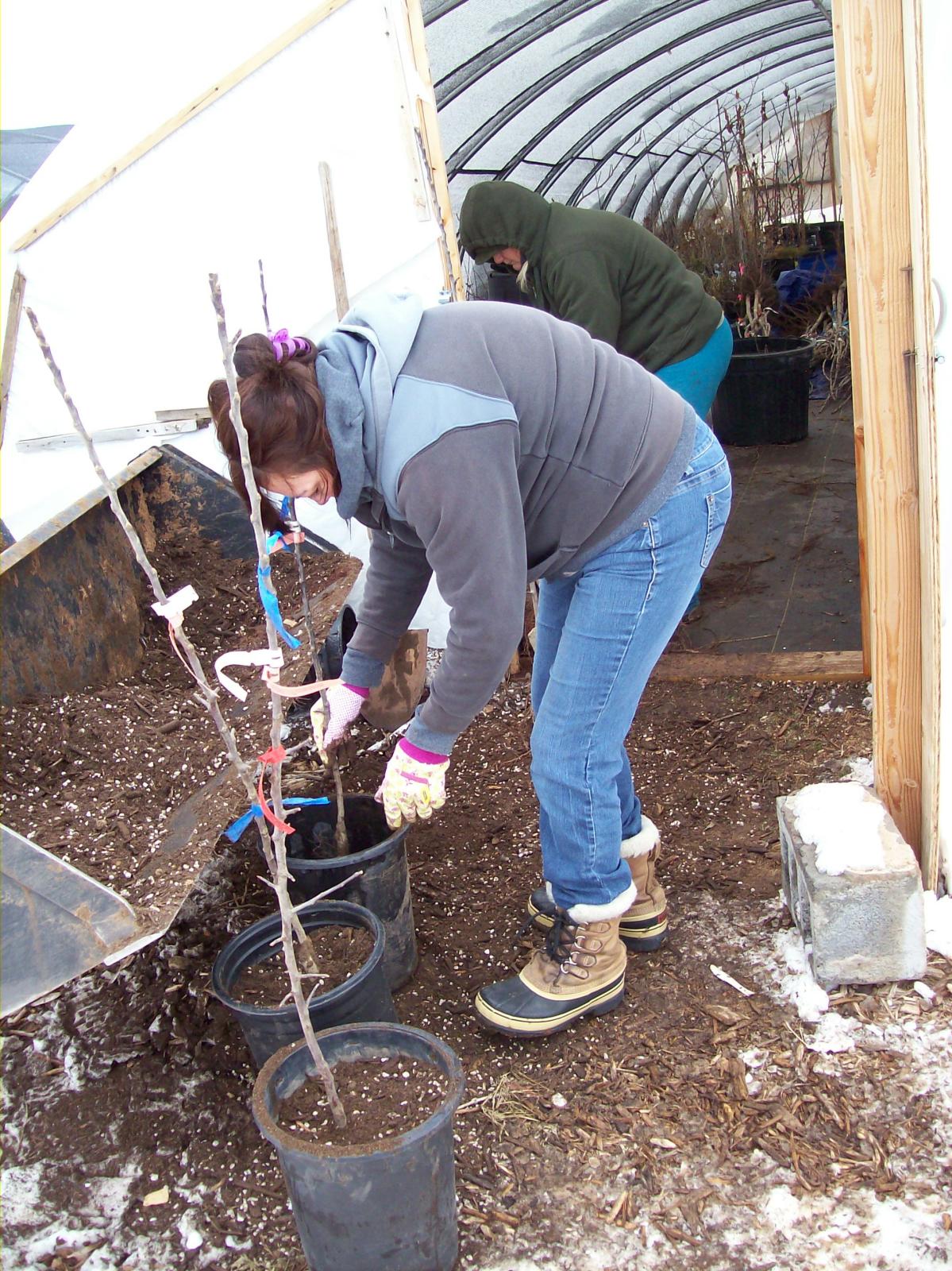
I worked on pruning the trees, removing broken or damaged limbs, reducing the height of the trees, shaping the roots to fit into the pots. There's a lot of debate about the best way to prune fruit trees. I like a tree that's beautiful in the landscape as well as productive, so I tend to be conservative about removing wood. It's true that trees that are aggressively pruned are shorter and easier to harvest, but I don't mind dragging a ladder around--or boosting the kids.
Tina and Aly potted them in the mix we got from Soilutions--40% premium compost, 40% forest floor mulch, and 20% pumice--good drainage. Aly and Wink toted the heavy pots and arranged them in our sunken bed. 130 trees is a lot of toting and they were all pretty tired by the time we finished. Previous blogs have covered the technique we're using to warm the roots in the sunken bed--it was great to see that Wink's calculations left ample room for the 130 trees (including the 10 that went missing).
After the trees were all in place we packed compost around to help hold the heat, then gave them a good watering. By that time the sun had melted most of the snow, things were getting muddy, and the wind was coming up so we decided not to try to put the plastic over the hoops--that's next.
 With luck, Mountain Gardens will have a nice mix of fruit to sell this coming season. Some antique apples like Hudson's Golden Gem and Belle de Boskoop, Arkansas Black and Honeycrisp; a 4 in 1 cherry, North Star Dwarf, and Stella; an expaliered pear; an Italian prune, Superior plum, and a green Gage-Bavay plum; three kinds of peaches.
Sunday, February 5, 2012
Another Installment on the Fruit Tree Hoophouse
We spent part of the weekend working on the heat box for the fruit tree hoophouse. Only a couple of days left till they get here! We had rescued an old solar heater--it's been sitting on the rescue pile out there for about three years. (Hope it's not another three years before the rest of that stuff gets repurposed!)
 So Wink has been deconstructing this very well made behemoth--taking out all the bracing and rivets--that was the time consuming part. Got the casing opened up, and we ran 2" pvc schedule 40 inside against the insulation. Put the halves back together with foam insulation, and then sheet metal screwed it together, and put the braces back on.
The pvc gets filled with antifreeze. The heated antifreeze gets pumped through the pipe under the trees--et voila, warm soil, warm roots--growth! Wink used his math skills to calculate the volume inside the pipe. We found some special anti-freeze online--pure glycerine--but pricy so wanted to get only what we needed.
Next step--get the heater hooked up to the panel.
(Yes, I am blogging during the super bowl. Wink and Bel are watching, but I'm only interested in the commercials!)
 So Wink has been deconstructing this very well made behemoth--taking out all the bracing and rivets--that was the time consuming part. Got the casing opened up, and we ran 2" pvc schedule 40 inside against the insulation. Put the halves back together with foam insulation, and then sheet metal screwed it together, and put the braces back on.
The pvc gets filled with antifreeze. The heated antifreeze gets pumped through the pipe under the trees--et voila, warm soil, warm roots--growth! Wink used his math skills to calculate the volume inside the pipe. We found some special anti-freeze online--pure glycerine--but pricy so wanted to get only what we needed.
Next step--get the heater hooked up to the panel.
(Yes, I am blogging during the super bowl. Wink and Bel are watching, but I'm only interested in the commercials!)
Saturday, February 4, 2012
Funny Little Heart-shaped Cotyledon

Was plucking out some ptelea trifoliata (wafer ash) and found this double cotyledon. Don't know if this is a normal event or not, but thought it was worth a photo.We weren't expecting to see these so soon, either.
The germination instructions said that they could take two (2!) years to germinate using a regimen of two months heat/ two months cold/two months heat...and so on. We put it in the fridge for two months, and darned if the seeds didn't start germinating the first time on the heat mat. None of the other ptelea seed had a double cotyledon either. Hmmm. Planted it even though the seedlings may be flawed.

Still exciting whenever any reportedly difficult native germinates well. And this is one that we haven't been able to find anywhere else (got the seed from prairiemoon.com). It will probably be at least five years before it goes over to the shop; it's supposed to be a slow growing little tree. Native to New Mexico, it's one of the woodland understory trees, but will take a wide range of conditions including full sun and drought. It has a pretty white flower in late spring, a lemony aroma that may or may not be objectionable. If kept cut back it will form a bushy tall shrub, but can be kept to a single trunk, too. It's a favorite larval food of the giant swallowtail butterfly.
Another name for the wafer ash is hoptree--it used to be a substitute for hops in beer. And since it's not an ash, fraxinus, it won't be plagued by the ash borer when it arrives.
Friday, February 3, 2012
Herbs Popping Up

If all goes well on the heat mats, we should have a nice selection of herbs this year including some unusual ones. We'll have the standards: flat & curley parsley, three kinds of basil, borage, dill, fennel, thyme, oregano, marjoram, lemon balm, spearmint & peppermint, rosemary, rue, pennyroyal (not culinary, but it was really nice in containers last year), and stevia if we can surmount germination issues. Chives of course, both onion and garlic. They're nice in flower beds too. Lavenders if we can find them. Like the creeping thymes, they're hard to keep in the greenhouse, so we buy them locally.
We're experimenting with angelica, an old fashioned herb that grandma candied. It has a sweet aroma, and has been used for centuries as a flavoring and vegetable good for digestion. It's harvested in its second year, and can reach six feet tall!
Roselle is in the mallow family, a vivid yellow hibiscus type flower. It's used to make refreshing drinks among other things. The calyces, the fleshy bottom part of the flower, lends a deep red color. Roselle is used extensively in Asia, India, the middle East, and Europe for food and medicine.
Marsh Mallow used to be the base for, what else, marshmallows. It's been used for thousands of years both for medicine and food. It has a showy pink hibiscus type flower.
Papaloquelite is a native South American annual. It's used in Mexican recipes for cilantro flavor. Always fresh, never cooked.
We had a number of folks ask us for epazote or Mexican tea, another seasoning for a variety of Mexican dishes, so we'll have it too. It's often used in beans and is believed to prevent flatulence. Guess it's used a lot. It has a pungent aroma. The newer leaves aren't as strong as older ones; use sparingly. Can become weedy. Used by the Aztecs.
Space is always an issue for us so some of these will probably be available in limited quantities.
Saturday, January 28, 2012
Fast, Economical Hoophouse
 A while back, I shared a bit about the hoophouse class we took at CNM's Workforce Training Center. Today, we put our class material to the test as we finally erected the arcs for the hoophouse. I already shared some pics of the foundation work we did--today we erected the arcs for our fruit tree house--none too soon for the trees should arrive in a little more than a week.
 Wink and Nathan spent about an hour cutting the lengths of 2" pvc, then positioned all the pieces. To recap, the trench will hold the 5 gallon pots which will be buried to capture the heat from hot water that will be circulating under them. While the tops of the trees don't need warmth, the covered hoops will keep out wind and varmints.

The twenty foot lengths will form an arch about ten feet high. We needed to glue up a series of rectangles, each formed from two long and two short sections.

It was cold, in the 30's, and we were concerned that the pvc was going to resist being bent. (Windy too, but when isn't it?).
The rectangles get braced against the 2x10s on the left, and Aly stood on the side piece to keep it from popping up.


I think we were all a little surprised when that first rectangle went up just like our instructor said it would! So far we've put up five commercial hoophouses, and they've all been difficult (not as hard as our first house though where we milled our own beams), and I was dreading this. But it went together easily, without a single hitch, in a matter of maybe three hours.

As each rectangle went up, it was attached to the preceding rectangle with a short length of pvc so the arcs are all on 4' centers. We anchored the bases to the wood on both sides with plumbers strap.

We screwed lengths of 3/4" pvc along the sides of the hoophouse and were again surprised as how much stability the hoops gained. Both ends are braced laterally as well.
We won't cover the house with plastic until we get all the pots in--much easier being able to pass them through the open ribs. 5 gallon pots get mighty heavy after the 90th or so.
Still have to rig the solar pump and heater--but this was the hard part, or so we thought....
Tuesday, January 24, 2012
Trop3

The jade also grows outside in California where its often used as a flowering hedge, but like all the plants these last blogs have featured, they can't take our freezes. If taken out in the summer, they should be protected from high wind, and may suffer from our high altitude sunlight. A little shade at hign noon please!

 I've used my pineapple tops for years to start new plants. I leave about a half inch of fruit when I cut the tops away, and firmly settle the top in a pot of soil. Keep evenly moist but not sopping wet or they'll rot. They will also root in water if you're patient. Keep the water fresh.
Subscribe to:
Posts (Atom)